Showing posts with label week 9. Show all posts

Saturday, February 29, 2020

Wikipedia Trail: From Yajna to Shaktism

In this week's reading, I came across the term yajna. It means sacrifice, worship, offering, or devotion. In Hinduism, it is often a ritual with mantras performed in front of a sacred fire. The tradition began as offerings to gods in sacred fire and transformed into "symbolic offerings in the presence of sacred fire."

That article led me to Agni, which means fire in Sanskrit. It is also associated with the Vedic fire god in Hinduism. Agni guards the southeast direction, and he is the mouth of the gods and goddesses. Agni (fire) is also one of the five elements in Indian religious cosmology.

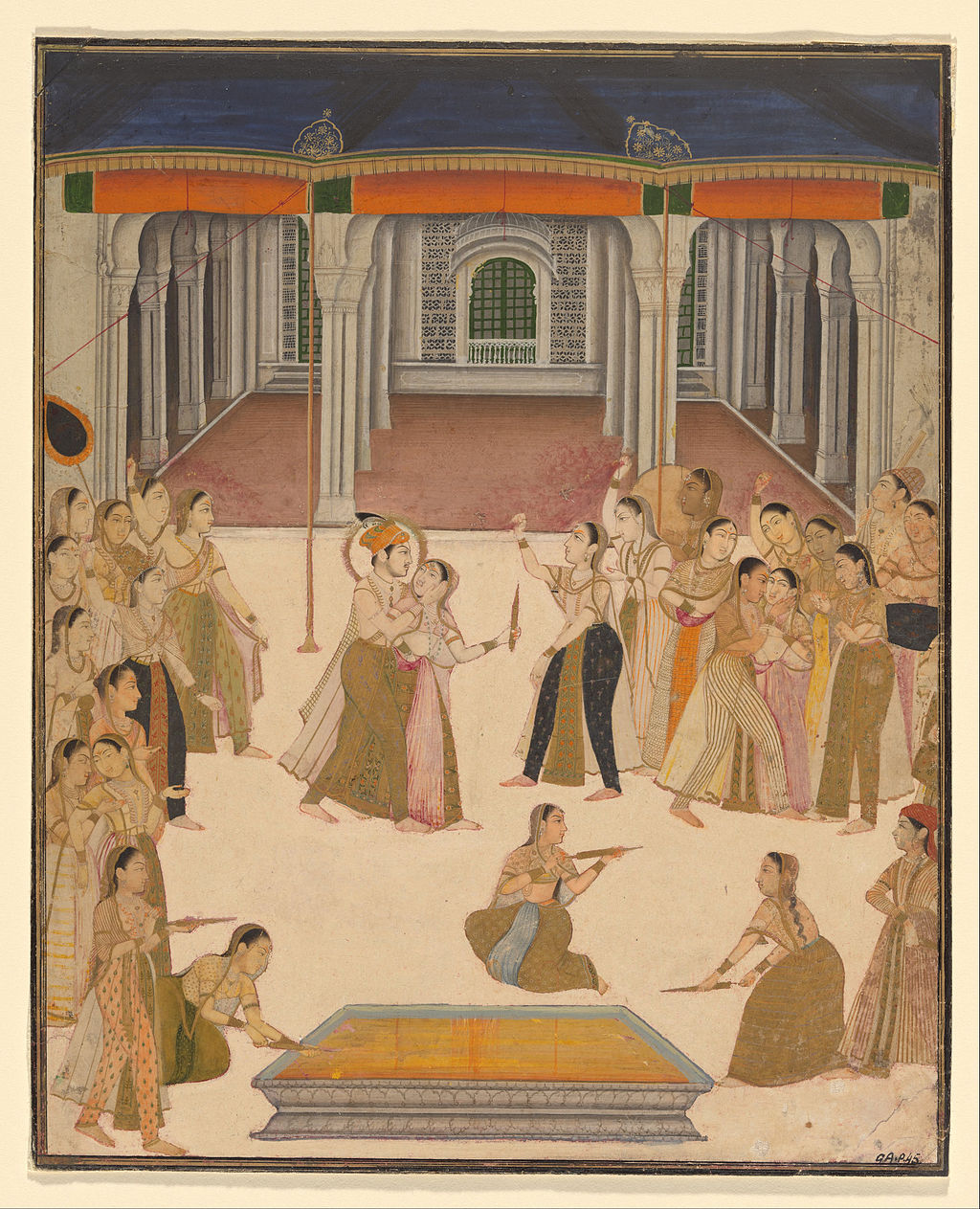
Agni led me to Holi, which I have heard of before but never knew the significance. Holi is an ancient Hindu festival that is known as the "festival of colours/love/spring." It's purpose is to recognize the end of winter and the beginning of spring. It gives people a chance to "repair broken relationships" and just take care of each other. What a beautiful celebration!

That led me to Shaktism, which is a Hindu tradition where "the metaphysical reality is considered metaphorically feminine and Shakti is regarded as the supreme godhead." I was pretty confused by this article, but generally I think Shaktism is a denomination of Hinduism where certain goddesses are seen as the highest powers. 

Week 9 Reading Notes: Nine Ideal Indian Women, Part B

  • Sati falls in love with Siva. 
  • I really loved this quote that shows Siva's character: "When he called Siva a beggar, Daksha Raj spoke truly, for among all the gods there was none so poor as Mahadeva, who owned the whole creation but had nothing it it to call His own, for He had given all to others and had for Himself only an ox." (page 2)
  • Pages 3-4 give some really beautiful description about Sati and Siva enjoying a peaceful life together.
  • Sati goes to her father's yagna that she was not invited to. 
  • Sati ends up dying because her father's disapproval of her choices. Siva is enraged and begins to destroy the world, but Vishnu helps to reverse this by putting pieces of Sati's body on Earth. These became temples of Siva. 

"Sati shiva bishnu" from Wikimedia Commons
______

Bibliography: Nine Ideal Indian Women: Savitri, Damayanti, Sati, and Uttara, by Sunity Devee.

Week 9 Reading Notes: Nine Ideal Indian Women, Part A

  • Savitri falls in love with a boy (Satyaban) in the forest. It turns out he is an exiled prince. Savitri's father doesn't want her marrying him because he was an "exiled beggar" but he also doesn't want her to be forced into obedience. He learns that the boy's father (the king) was surrounded by enemies from day one on the throne, making it really difficult to rule anyways. Then the king became blind, and he was eventually driven out of the kingdom by his brother. Satyaban and his mom followed him into exile. This makes Savitri's father more okay with her marrying him, but then he learns that Satyaban is destined to die within a year (which reminds me of The Raven Cycle!!! That is a key point of that book! I wonder if that's where she got the idea...).
  • Savitri still wants to marry him despite knowing he'll die in a year.
  • The way their love is written about is really beautiful. I might write about a single moment/day in their relationship where they are just doing daily domestic activities, helping Satyaban's parents, but both of them are admiring each other, and Savitri is trying hard not to think about how she will live without him.
  • When Satyaban dies, the King of Death comes. Savitri begs him not to take Satyaban's body, but eventually gives in. She follows the King of Death, saying that she can't live without Satyaban so he should take her also. The King of Death says he will grant her wishes if she stops following him. She wishes for: her father-in-law's sight back, her father to have a son as an heir, and sons for herself. She then says that all of that is pointless to her if she doesn't have Satyaban, and she also wishes to die. The King of Death is surprised and realizes he has been conquered (love this!!! Reminds of Harry Potter). He gives Savitri her husband back. 
  • Satyaban wakes up and thinks he has been sleeping there all night. Savitri doesn't tell him he died. This could also make a really interesting story--they continue gathering wood, and I could write about how Savitri is looking at Satyaban, thoughts racing and admiring him. 
  • I love how everything just fell together perfectly in this story. Everything had a purpose: the birth of a girl instead of a boy, the exile, the wishes, the death, etc. 
Savitri and Satyavan from Wikimedia Commons

____

BibliographyNine Ideal Indian Women: Savitri, Damayanti, Sati, and Uttara, by Sunity Devee.

Week 9 Microfiction: Harry Potter, Book Four

The Perils of War Show No Mercy: Cedric Diggory

A flick, a flash; an innocent, pure heart stopped. A pointless murder, but a necessary one all the same. 

Book Four

The beginning of a darker time. 


______

Author's Note:

My two sentence microfiction is about Cedric Diggory, who was murdered on Voldemort's orders. Diggory is one of my favorite characters, and it took me two re-reads to finally accept his death. At first, I was completely distraught because it felt pointless. But the more I thought about it, the more I realized that Diggory's death was a pivotal moment in the books. It was the evidence many people needed to realize that Voldemort was back, and that he was going to do whatever horrible things he had to to achieve power. Killing Diggory was one of the biggest mistakes Voldemort made for so many reasons, but the biggest was that it brought people together. Anyways! I wanted to make it a six-word story but in the end I realized a short two-sentence story was more meaningful. Also, I really like the idea of creating a long title for such a short story. It feels kind of silly but also important. It forces the reader to take in every single word and gives them more to analyze.

My six-word story is about the book in general. The ending of The Goblet of Fire is a turning point in the series that introduces some very intense and unsettling content. I wanted to convey this in a succinct way, and I think a six-word story does it well.

Bibliography: Harry Potter and the Goblet of Fire by J.K. Rowling

Image information: Harry Potter and the Goblet of Fire poster from Flickr. I haven't seen this before and I thought it was so good!

Monday, January 13, 2020

Tech Tip: Animated Gif

I used gifmaker.me to make this gif of my dog, Yumi. I like the idea of using a gif maker to create a sort-of slideshow, rather than just a moving image!


~~~

Image info: Personal images of Yumi, 2019-2020